MiniBook Introduction
Posted: Sat Dec 20, 2025 4:29 pm
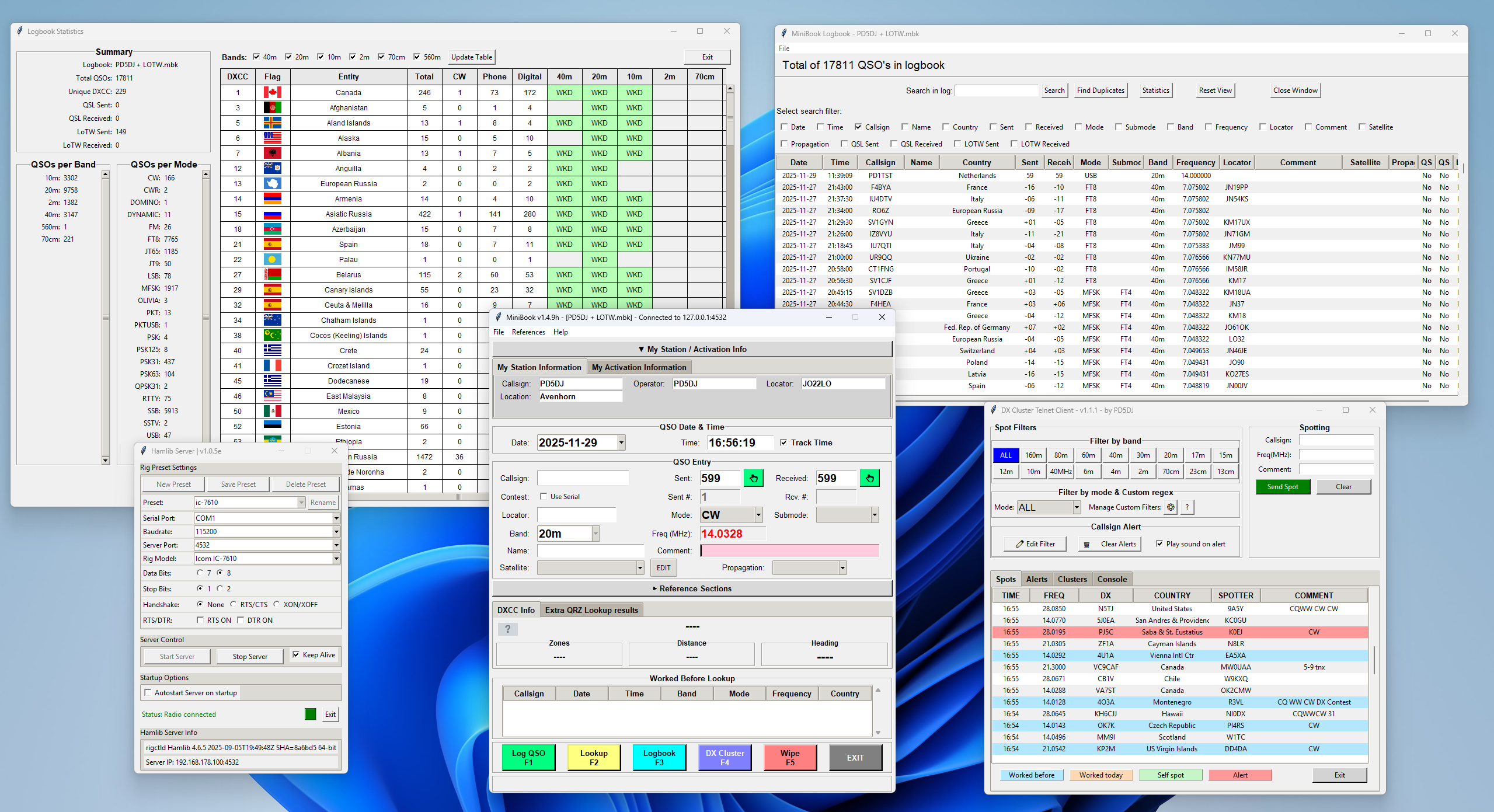
What is MiniBook?
MiniBook is a modern, lightweight yet extremely powerful logging and station-integration suite for radio amateurs. It is designed with one clear objective: fast, reliable, and structured operation during everyday QSOs, portable activities, DXing, and contesting.
MiniBook is not just a logbook. It is a central operating hub that connects logging, rig control, DX cluster spotting, online services, and station automation into a single, coherent workflow.
Origins & History of MiniBook
MiniBook started as a personal experiment rather than a planned product.
Through professional work involving test scripting, hardware/software validation, database handling, and automation using Python, the idea arose to explore how quickly a small, practical logging tool could be built from scratch.
The original goal was intentionally modest:
- Create a small test logbook
- Keep it simple and robust
- Focus on field operation rather than a full desktop logging suite
- Design everything around one compact screen, suitable for tablet use
Very quickly, this experiment evolved beyond its initial scope.How little is actually needed to log QSOs efficiently in the field?
Field-Oriented Design
From the beginning, MiniBook was designed with portable and outdoor operation in mind:
- Large, clear input fields
- Minimal window clutter
- Logical left-to-right and top-to-bottom workflow
- No hidden dependencies on internet connectivity
Why Python and Open Source
Python was a deliberate choice.
Using Python meant:
- No complex build or compilation process
- Fast iteration and experimentation
- Easy debugging and modification
- Direct access to mature libraries for networking, GUI, and data processing
- Inspect how things work internally
- Modify behavior for their own station
- Extend functionality without reverse engineering
From Test Log to Station Ecosystem
As MiniBook matured, real-world operating revealed new requirements:
- DXCC and prefix intelligence
- Rig frequency tracking
- DX Cluster integration
- Contest-style workflows
- Award and reference handling
- Logging focused purely on data integrity and workflow
- Rig control delegated to a dedicated Hamlib layer
- DX Cluster handling separated for performance and clarity
MiniBook is built around a few fundamental principles:
- Local-first design – Your data stays on your system in open formats
- Operator control – No forced cloud dependency
- Modular architecture – Each component can run standalone or fully integrated
- Performance oriented – Optimized disk I/O, caching, and background threading
- Radio-centric workflow – The radio is always the reference point
JSON-Based Logbook Engine
MiniBook uses a custom JSON logbook format designed for speed, flexibility, and long-term maintainability.
- Very fast loading and saving
- Automatic logbook format upgrades
- Built-in backup handling
- Efficient operation with large logbooks
- Import from other logging applications
- Export full logbooks or selected QSOs
- Contest, POTA, and WWFF-specific exports
- Robust encoding detection (UTF-8 / Latin-1)
- Edit and delete QSOs safely
- Multi-select bulk editing
- Duplicate QSO detection
- Worked-before and worked-today highlighting
- Automatic band and frequency validation
DXCC & Prefix Handling
- cty.dat based DXCC recognition
- Intelligent prefix parsing
- Portable and compound callsign support
- Maidenhead locator validation
- Automatic distance calculation
- Real-time heading updates
- DXCC
- IOTA
- SOTA
- POTA
- WWFF
- BOTA
- COTA
- Satellite operations
- Live frequency polling
- Live mode polling
- Automatic band detection
- Network-based rig connections
- Automatic reconnect handling
What is a DX Cluster?
A DX Cluster is a real-time network where radio amateurs post and receive activity reports (spots) of stations currently on the air.
Each spot typically includes:
- Callsign
- Frequency
- Mode
- Spotter
- Optional comments
- Buffered high-performance spot processing
- Band and mode filtering
- Custom regular-expression filters
- Callsign alerts with sound notifications
- Automatic reconnect logic
- Clicking a spot tunes the radio
- Callsign and frequency are sent to MiniBook
- Worked-before and worked-today highlighting
- Self-spot visibility
- Portable operators (POTA, SOTA, WWFF)
- DX-focused casual operating
- Field operation and expeditions
- Home stations that value simplicity and control
- Operators who want full ownership of their logbook data
- If you need a full contest logger with scoring and multipliers
- If you require automatic award tracking and validation
- If you rely on heavy SO2R or macro-driven contest workflows
- If you simply do not like logging QSOs at all


MiniBook is not simply another logging application.
It is a complete station ecosystem that integrates logging, rig control, DX spotting, geographic intelligence, and web publishing into a single, operator-focused solution.
Designed by a radio amateur, for radio amateurs — with performance, clarity, and reliability as its foundation.